Showing posts with label Divide and Conquer. Show all posts

Shuffling a linked list


https://www.cnblogs.com/evasean/p/7232572.html
Shuffling a linked list. Given a singly-linked list containing n items, rearrange the items uniformly at random. Your algorithm should consume a logarithmic (or constant) amount of extra memory and run in time proportional to nlogn in the worst case.
此题要求对单向链表进行随机排序,可以考虑先实现个链表的归并排序(见我的另一篇文章),再改造成这里的随机排序。

 70     private Node sort(Node head){
 71         if(head == null || head.next == null) return head;
 72         Node slow = head;
 73         Node fast = head;
 74         //取中间节点
 75         while(fast.next != null && fast.next.next != null){
 76             slow = slow.next;
 77             fast = fast.next.next;
 78         }
 79         Node left = head;
 80         Node right = slow.next;
 81         slow.next = null; //将左右链表分开
 82         left = sort(left);
 83         right = sort(right);
 84         return merge(left,right);
 85     }
 86     private Node merge(Node left, Node right){
 87         //System.out.println("left="+left.element+",right="+right.element);
 88         Node aux = new Node(); //需要耗费logn的额外空间
 89         Node l= left;
 90         Node r = right;
 91         Node current = aux;
 92         while(l != null && r!=null){
 93             int rand = StdRandom.uniform(2);
 94             if(rand == 0){ //如果随机数选为0,则从左侧选取元素
 95                 current.next = l;
 96                 current = current.next;
 97                 l= l.next;
 98             }else{ //如果随机数选为1,则从右侧选取元素
 99                 current.next = r;
100                 current = current.next;
101                 r = r.next;
102             }
103         }
104         if(l!=null) current.next = l; // 如果左侧没遍历完,将其连接至current后
105         else if(r != null) current.next = r; //如果右侧没遍历完,将其连接至current后
106         return aux.next; //返回归并好的链表
107     }

https://web.stanford.edu/class/cs9/sample_probs/ListShuffling.pdf


Binary Search on Unsorted Array - 1point3acres


https://docs.google.com/document/d/1qxA2wps0IhVRWULulQ55W4SGPMu2AE5MkBB37h8Dr58/

随机数组中用二分法找不到的元素

第四题,一个印度小哥,给定一个没有排序的随机数组,使用二分法找数组里的各个元素,返回有多少元素是用二分法永远找不到的。要求算法复杂度为O(n), 楼主不会。印度小哥让楼主用例子试一试,看看能不能找到什么规律。楼主试了试,没找到规律…………最后给出了nlog(n)的解法,估计最后挂在这了。

思路:
可以用类似于判断树是否为BST的思路:维护一个“值域”R=(lo, hi)(即在当前搜索下标范围[i, j]内,只有在R范围内的数才有可能被二分法找到)。求得当前搜索范围[i, j]的中点mid。如果A[mid]在当前的R中,那A[mid]就一定能被找到。然后分别递归mid的左右两侧[i, mid-1]和[mid+1, j]。递归左侧时,允许的值域是(lo, A[mid]);同理右侧的值域是(A[mid], hi)。如果任何时刻发现值域R已经不包含任何整数,那就表示[i, j]这个下标范围内没有任何能找到的数字。

code
provider: null
   private int find(int[] nums) {
    // do some sanity check operations
    return dfsUtil(nums, 0, nums.length - 1, Integer.MIN_VALUE, Integer.MAX_VALUE);
   }
   private int dfsUtil(int[] nums, int left, int right, int lower, int upper) {
// base case: there should be no elements between (lower, upper) or (left,right)
    if(lower >= upper) return right - left + 1;
    if(left > right) return 0;
   
    int mid = left + (right - left) / 2;
    int l = dfsUtil(nums, left, mid-1, lower, nums[mid]);
    int r = dfsUtil(nums, mid+1, right, nums[mid], upper);
    if(nums[mid] > lower && nums[mid] < upper) {
    return l + r;
    } else {
    return l + r + 1;
    }
   }

需要和面试官clarify是否包含重复值,如果包括,情况会更复杂一点。首先需要定义二分法是找左边界还是右边界,其次,不同位置同样的数是否当做同样的值。提供一个python版本代码。
def bs_in_unsorted_arr(unsorted):
   from collections import defaultdict
   lo, hi = -1 << 32,1 << 32
   left, right = 0, len(unsorted)
   found = defaultdict(bool)
   def bs(left, right, lo, hi):
       if left >= right:
           return
       if lo >= hi:
           return
       mid = (left + right) >> 1
       if lo <= unsorted[mid] < hi:
           found[unsorted[mid]] = True
       bs(left, mid, lo, min(unsorted[mid], hi))
       bs(mid + 1, right, max(unsorted[mid], lo), hi)
   bs(left, right, lo, hi)
   return found

无序数组二分搜索:找不到的数
假设给你一个有序数组,,那么如果二分搜索其中的每个数,必定都能找到。
如果给你同样的数组,但是却是打乱的,然后使用同样的二分搜索来搜索其中的每个数,会有些数找不到。
请你用 O(N),返回哪些数找不到。

把这个无序数组直接用binarySearch 来搜索 [ 2, 7, 9, 10, 1 ]

l=0, h=4, m=2, 找9一次就可以找到。
找2,m=2 是9,所以在左边。则l=0, h=1, m=0, 可以找到
找7,m=2 是9,所以在左边。则l=0, h=1, m=0, 然后 l=1, h=1, m=1 可以找到
找10,m=2 是9,所以在右边。则l=3,h=4,m=3,能找到
找1,m=2 是9,所以在左边。则l=0,h=1,m=0 找不到。

所以对于这个题目,找不到的数是【1】。


如果知道中位数,则左半部>中位数和右半部<中位数的数会找不到。
那么如何在O(n)时间内找到中位数,可以用两个堆来找,或者平衡二叉树也可以。

再加一个例子:
Given nums: [22, 92, 25, 16, 29, 15, 49, 22, 38, 61]
Can't find: [16, 49, 25, 92, 15]
对于任意数组中的元素,如果用标准的二分法搜索搜索不到,就是最后答案的一员。当然下面的是测试代码,达不到楼顶要求的O(N)了。
for (int j : nums)
  if (Arrays.binarySearch(nums, j) < 0)
    System.out.println("Can't find " + j);

用堆或者Balanced BST的时间复杂度就不是O(N)了,找中位数果断用Quick Select啊

然后考虑一个样例数组,比如
[4, 3, 5, 7, 6, 8, 2, 9, 1]

假设我们需要寻找8,那么输出是这样的:
  1. Looking at position 4, value = 6
  2. Now decide whether left [0, 3] or right [5, 8]
  3. Go to right side!
  4. Looking at position 6, value = 2
  5. Now decide whether left [5, 5] or right [7, 8]. From 1point 3acres bbs
  6. Go to right side!
  7. Looking at position 7, value = 9
  8. Now decide whether left [7, 6] or right [8, 8]
  9. Go to left side!
  10. Not found
也就是找不到8 —— 问题出在第二步position = 6的值为2,所以我们将左边的区间[5, 5]排除了。
. From 1point 3acres bbs
那么进入区间[5, 5]的条件是什么?—— 条件是查找值要大于第一步position = 4的值(也就是6)从而向右走,并小于第二步position = 6的值(也就是2)从而向左走,也就是查找值要大于6并小于2 —— 当然这个条件不可能被满足,所以不仅是7,position = 5的位置设成任何值都是不可能被找到的。

所以总体思路就是维护一个“查找值需要大于X并小于Y才能到达这个区间“的记录,并在递归的每一层更新X和Y

  1. void CheckHidden(const std::vector<int> &data,
  2.                  std::vector<bool> &hidden,
  3.                  const int lo, const int hi,
  4.                  const int min_bound, const int max_bound) {
  5.   if (lo > hi) {
  6.     return;. From 1point 3acres bbs
  7.   }

  8.   const int mid = (lo + hi) / 2;
  9.   const int value = data[mid];

  10.   // 打印更新边界的过程
  11.   std::cout << "data[" << mid << "] = " << data[mid] << ", bound = "
  12.             << "[" << min_bound << ", " << max_bound << "]]\n";

  13.   // hidden记录每个位置的值是否能被查找到
  14.   hidden[mid] = (value <= min_bound || value >= max_bound);

  15.   CheckHidden(data, hidden, lo, mid-1, min_bound, std::min(value, max_bound));
  16.   CheckHidden(data, hidden, mid+1, hi, std::max(min_bound, value), max_bound);
  17. }

  18. // Wrapper
  19. void CheckHidden(const std::vector<int> &data, std::vector<bool> &hidden) {
  20.   // 初始边界是负无穷到正无穷. From 1point 3acres bbs
  21.   CheckHidden(data, hidden, 0, data.size() - 1,
  22.               std::numeric_limits<int>::min(),
  23.               std::numeric_limits<int>::max());
  24. }


Closest Pair of Points


https://www.geeksforgeeks.org/closest-pair-of-points-using-divide-and-conquer-algorithm/
We are given an array of n points in the plane, and the problem is to find out the closest pair of points in the array.
https://www.hackerearth.com/practice/math/geometry/line-sweep-technique/tutorial/
A sweep line is an imaginary vertical line which is swept across the plane rightwards. That's why, the algorithms based on this concept are sometimes also called plane sweep algorithms. We sweep the line based on some events, in order to discretize the sweep.
The events are based on the problem we are considering , we'll see them in the algorithms discussed below. Other than events, we maintain a data structure which stores the events generally sorted by y coordinates (the criteria for ordering of data structure may vary sometimes) which is helpful in the processing when we encounter some event. At any instance, the data structure stores only the active events.
One other thing to note is that the efficiency of this technique depends on the data structures we use. Generally , we can use set in C++ but sometimes we require some extra information to be stored, so we go for balanced binary tree.

For this problem, we can consider the points in the array as our events.
And in a set, we store the already visited points sorted by y coordinate.
So, first we sort the points in x direction as we want our line to move towards right.
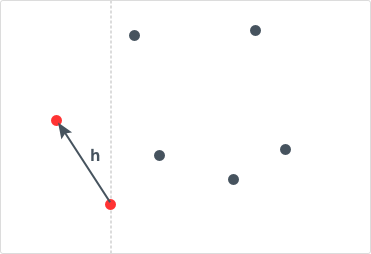
Now, suppose we have processed the points from 1 to N-1, and let h be the shortest distance we have got so far. For Nth point, we want to find points whose distance from Nth point is less than or equal to h.
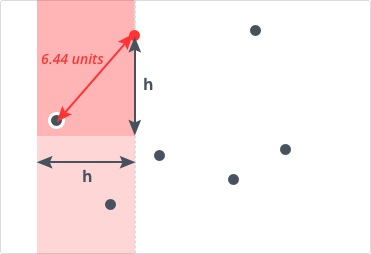
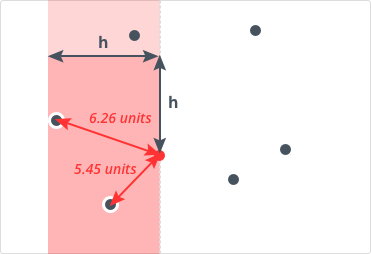
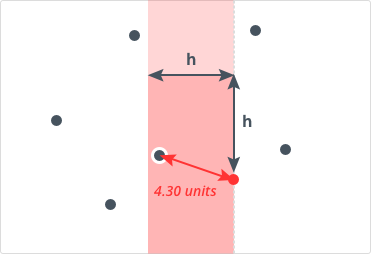
Now, we know we can only go till h distance from xN to find such point, and in the y direction we can go in h distance upwards and h distance downwards. So, all such points whose x coordinate lie in [xNh,xN] and y coordinates lie in [yNh,yN+h] are what we are concerned with and these form the active events of the set . All points in the set with x coordinates less than xNh are to be deleted . After this processing, we'll add the Nth point to the set.
One thing to note is that at any instance, the number of points which are active events is O(1)(there can be atmost 5 points around a point which are active excluding the point itself).
Okay, that's a lot of theory, let's see this algo running
enter image description here enter image description here

Initialize h as the distance between first two points Update the value of h if present distance between points is less than h
enter image description here enter image description here
The red region in the image is the region containing points which are to be evaluated with the current point.The points left to this region are removed from the set.

Let's break down the points in the code:
1. First ,we have sorted the array of points on x coordinates.
2. Then we inserted the first point in the pnts array to the set box. Note we have defined py as the first in the pair, so set will be sorted by y coordinates.
3. In the loop , for each point in pnts, we are removing the points to the left of the current point whose x coordinate has more distance than h(the current minimum distance) from xN.This loop runs for overall O(N) as we have only N elements in the set. The complexity of erase is O(logN). So, the overall complexity of this loop is O(NlogN)
4. In the second for loop , we are iterating over all points whose x coordinates lie in [xNh,xN] and y coordinates lie in [yNh,yN+h]. Finding the lower_bound takes O(logN) and this loop runs for atmost 5 times.
5. For each point, insert into the set. This step takes O(logN).
So, overall time complexity of the algorithm is O(NlogN)

#define px second
#define py first
typedef pair<long long, long long> pairll;
pairll pnts [MAX];
int compare(pairll a, pairll b)
{ 
        return a.px<b.px; 
}
double closest_pair(pairll pnts[],int n)
{
        sort(pnts,pnts+n,compare);
        double best=INF;
        set<pairll> box;
        box.insert(pnts[0]);
        int left = 0;
        for (int i=1;i<n;++i)
        {
            while (left<i && pnts[i].px-pnts[left].px > best)
                box.erase(pnts[left++]);
            for(typeof(box.begin()) it=box.lower_bound(make_pair(pnts[i].py-best, pnts[i].px-best));it!=box.end() && pnts[i].py+best>=it->py;it++)
                best = min(best, sqrt(pow(pnts[i].py - it->py, 2.0)+pow(pnts[i].px - it->px, 2.0)));
            box.insert(pnts[i]);
        }
        return best;
}
https://baptiste-wicht.com/posts/2010/04/closest-pair-of-point-plane-sweep-algorithm.html
With that algorithm, we'll sweep the plane from left to right (right to left is also a possibility) and when we reach a point we'll compute all the interesting candidates (the candidates that can be in the closest pair).
For that we'll make the following operations :
  1. We sort the list of points from left to right in the x axis
  2. And then for each point :
    1. We remove from the candidates all the point that are further in x axis that the current min distance
    2. We take all the candidates that are located more or less current min distance from the current point in y axis
    3. We test for the min distance all the founded candidates with the current point
    4. And finally we add the current point to the list of candidates
So when we found a new min distance, we can make the rectangle of candidates smaller in the x axis and smaller in the y axis. So we made a lot less comparisons between the points.
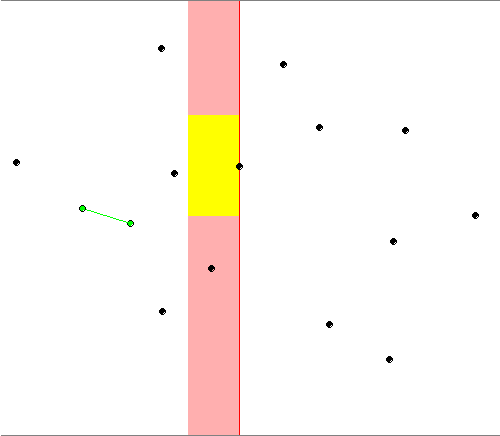
Here is a picture illustrating that :
Plane Sweep Algorithm
The red points are the closest pair at this time of the algorithm. The red rectangle is the rectangle of the candidates delimited in right by the current point. And the yellow rectangle contains only the candidates interesting for the current point.
There is always a maximum of 6 points in the yellow rectangle, the 4 vertices, the point with the same coordinates as the current point and finally the point in the same y coordinate and in the limit of the x axis. Even if the maximum is 6, you'll almost never have more than 2 points in that list (the maximum is see in my test was 3 with a collection of 1'000'000 random points). You can see this 6 points here :
Maximum points to compare
If all that stuff is not really clear for you, you can watch it in action here in a Java applet.
The candidates must also be always sorted. For that, we'll use a Binary Search Tree for good performances.
If we look at the complexity :
  • Sorting all the points in right axis : Cost O(n ln n) with Quick Sort by example
  • Shrinking the list of candidates take O(n) from start to end of the algorithm because we add n points to the candidates and we can remove only n points. So this is constant for each point : O(1).
  • Searching all the candidates between two values in y axis cost O(ln n) with binary search
  • The comparisons with at maximum 6 points are made in O(1)
  • Add the candidates and keep the list of candidates sorted cost O(ln n).
So the total complexity is O(n ln(n) + n * ( 1 + ln(n) + 1 + ln(n) ) ) = O(n ln n).

It's really easy to solve. We just have to found the number before which the naive algorithm is quicker than the sweeping and when the size of the points collection is smaller than this pivot number we use the naive implementation. On my computer I found that before 75 elements, the naive implementation was faster than the sweeping algorithm, so we can refactor our method :
public static Point[] closestPair(Point[] points) {
    if(points.length < 75){
        return naiveClosestPair(points);
    }

    //No changes
}
public static Point[] closestPair(Point[] points) {
    Point[] closestPair = new Point[2];

    //When we start the min distance is the infinity
    double crtMinDist = Double.POSITIVE_INFINITY;

    //Get the points and sort them
    Point[] sorted = Arrays.copyOf(points, points.length);
    Arrays.sort(sorted, HORIZONTAL_COMPARATOR);

    //When we start the left most candidate is the first one
    int leftMostCandidateIndex = 0;

    //Vertically sorted set of candidates
    SortedSet<Point> candidates = new TreeSet<Point>(VERTICAL_COMPARATOR);

    //For each point from left to right
    for (Point current : sorted) {
        //Shrink the candidates
        while (current.x - sorted[leftMostCandidateIndex].x > crtMinDist) {
            candidates.remove(sorted[leftMostCandidateIndex]);
            leftMostCandidateIndex++;
        }

        //Compute the y head and the y tail of the candidates set
        Point head = new Point(current.x, (int) (current.y - crtMinDist));
        Point tail = new Point(current.x, (int) (current.y + crtMinDist));

        //We take only the interesting candidates in the y axis
        for (Point point : candidates.subSet(head, tail)) {
            double distance = current.distance(point);

            //Simple min computation
            if (distance < crtMinDist) {
                crtMinDist = distance;

                closestPair[0] = current;
                closestPair[1] = point;
            }
        }

        //The current point is now a candidate
        candidates.add(current);
    }

    return closestPair;
}
https://www.cs.mcgill.ca/~cs251/ClosestPair/ClosestPairPS.html

X. Divide and Conquer
Following are the detailed steps of a O(n (Logn)^2) algortihm.
As a pre-processing step, input array is sorted according to x coordinates.
1) Find the middle point in the sorted array, we can take P[n/2] as middle point.
2) Divide the given array in two halves. The first subarray contains points from P[0] to P[n/2]. The second subarray contains points from P[n/2+1] to P[n-1].
3) Recursively find the smallest distances in both subarrays. Let the distances be dl and dr. Find the minimum of dl and dr. Let the minimum be d.
4) From above 3 steps, we have an upper bound d of minimum distance. Now we need to consider the pairs such that one point in pair is from left half and other is from right half. Consider the vertical line passing through passing through P[n/2] and find all points whose x coordinate is closer than d to the middle vertical line. Build an array strip[] of all such points.
5) Sort the array strip[] according to y coordinates. This step is O(nLogn). It can be optimized to O(n) by recursively sorting and merging.
6) Find the smallest distance in strip[]. This is tricky. From first look, it seems to be a O(n^2) step, but it is actually O(n). It can be proved geometrically that for every point in strip, we only need to check at most 7 points after it (note that strip is sorted according to Y coordinate). See this for more analysis.
7) Finally return the minimum of d and distance calculated in above step (step 6)
Time Complexity Let Time complexity of above algorithm be T(n). Let us assume that we use a O(nLogn) sorting algorithm. The above algorithm divides all points in two sets and recursively calls for two sets. After dividing, it finds the strip in O(n) time, sorts the strip in O(nLogn) time and finally finds the closest points in strip in O(n) time. So T(n) can expressed as follows
T(n) = 2T(n/2) + O(n) + O(nLogn) + O(n)
T(n) = 2T(n/2) + O(nLogn)
T(n) = T(n x Logn x Logn)

The great thing about the above approach is, if the array strip[] is sorted according to y coordinate, then we can find the smallest distance in strip[] in O(n) time. In the implementation discussed in previous post, strip[] was explicitly sorted in every recursive call that made the time complexity O(n (Logn)^2), assuming that the sorting step takes O(nLogn) time.

struct Point
{
    int x, y;
};
  
/* Following two functions are needed for library function qsort().
  
// Needed to sort array of points according to X coordinate
int compareX(const void* a, const void* b)
{
    Point *p1 = (Point *)a,  *p2 = (Point *)b;
    return (p1->x - p2->x);
}
// Needed to sort array of points according to Y coordinate
int compareY(const void* a, const void* b)
{
    Point *p1 = (Point *)a,   *p2 = (Point *)b;
    return (p1->y - p2->y);
}
  
// A utility function to find the distance between two points
float dist(Point p1, Point p2)
{
    return sqrt( (p1.x - p2.x)*(p1.x - p2.x) +
                 (p1.y - p2.y)*(p1.y - p2.y)
               );
}
  
// A Brute Force method to return the smallest distance between two points
// in P[] of size n
float bruteForce(Point P[], int n)
{
    float min = FLT_MAX;
    for (int i = 0; i < n; ++i)
        for (int j = i+1; j < n; ++j)
            if (dist(P[i], P[j]) < min)
                min = dist(P[i], P[j]);
    return min;
}
  
// A utility function to find minimum of two float values
float min(float x, float y)
{
    return (x < y)? x : y;
}
  
  
// A utility function to find the distance beween the closest points of
// strip of given size. All points in strip[] are sorted accordint to
// y coordinate. They all have an upper bound on minimum distance as d.
// Note that this method seems to be a O(n^2) method, but it's a O(n)
// method as the inner loop runs at most 6 times
float stripClosest(Point strip[], int size, float d)
{
    float min = d;  // Initialize the minimum distance as d
  
    qsort(strip, size, sizeof(Point), compareY); 
  
    // Pick all points one by one and try the next points till the difference
    // between y coordinates is smaller than d.
    // This is a proven fact that this loop runs at most 6 times
    for (int i = 0; i < size; ++i)
        for (int j = i+1; j < size && (strip[j].y - strip[i].y) < min; ++j)
            if (dist(strip[i],strip[j]) < min)
                min = dist(strip[i], strip[j]);
  
    return min;
}
  
// A recursive function to find the smallest distance. The array P contains
// all points sorted according to x coordinate
float closestUtil(Point P[], int n)
{
    // If there are 2 or 3 points, then use brute force
    if (n <= 3)
        return bruteForce(P, n);
  
    // Find the middle point
    int mid = n/2;
    Point midPoint = P[mid];
  
    // Consider the vertical line passing through the middle point
    // calculate the smallest distance dl on left of middle point and
    // dr on right side
    float dl = closestUtil(P, mid);
    float dr = closestUtil(P + mid, n-mid);
  
    // Find the smaller of two distances
    float d = min(dl, dr);
  
    // Build an array strip[] that contains points close (closer than d)
    // to the line passing through the middle point
    Point strip[n];
    int j = 0;
    for (int i = 0; i < n; i++)
        if (abs(P[i].x - midPoint.x) < d)
            strip[j] = P[i], j++;
  
    // Find the closest points in strip.  Return the minimum of d and closest
    // distance is strip[]
    return min(d, stripClosest(strip, j, d) );
}
  
// The main functin that finds the smallest distance
// This method mainly uses closestUtil()
float closest(Point P[], int n)
{
    qsort(P, n, sizeof(Point), compareX);
  
    // Use recursive function closestUtil() to find the smallest distance
    return closestUtil(P, n);
}

https://www.geeksforgeeks.org/closest-pair-of-points-onlogn-implementation/
The great thing about the above approach is, if the array strip[] is sorted according to y coordinate, then we can find the smallest distance in strip[] in O(n) time. In the implementation discussed in previous post, strip[] was explicitly sorted in every recursive call that made the time complexity O(n (Logn)^2), assuming that the sorting step takes O(nLogn) time.
In this post, we discuss an implementation where the time complexity is O(nLogn). The idea is to presort all points according to y coordinates. Let the sorted array be Py[]. When we make recursive calls, we need to divide points of Py[] also according to the vertical line. We can do that by simply processing every point and comparing its x coordinate with x coordinate of middle line.
T(n) = 2T(n/2) + O(n) + O(n) + O(n)
T(n) = 2T(n/2) + O(n)
T(n) = T(nLogn)

// A utility function to find the distance beween the closest points of
// strip of given size. All points in strip[] are sorted accordint to
// y coordinate. They all have an upper bound on minimum distance as d.
// Note that this method seems to be a O(n^2) method, but it's a O(n)
// method as the inner loop runs at most 6 times
float stripClosest(Point strip[], int size, float d)
{
    float min = d;  // Initialize the minimum distance as d
  
    // Pick all points one by one and try the next points till the difference
    // between y coordinates is smaller than d.
    // This is a proven fact that this loop runs at most 6 times
    for (int i = 0; i < size; ++i)
        for (int j = i+1; j < size && (strip[j].y - strip[i].y) < min; ++j)
            if (dist(strip[i],strip[j]) < min)
                min = dist(strip[i], strip[j]);
  
    return min;
}
  
// A recursive function to find the smallest distance. The array Px contains
// all points sorted according to x coordinates and Py contains all points
// sorted according to y coordinates
float closestUtil(Point Px[], Point Py[], int n)
{
    // If there are 2 or 3 points, then use brute force
    if (n <= 3)
        return bruteForce(Px, n);
  
    // Find the middle point
    int mid = n/2;
    Point midPoint = Px[mid];
  
  
    // Divide points in y sorted array around the vertical line.
    // Assumption: All x coordinates are distinct.
    Point Pyl[mid+1];   // y sorted points on left of vertical line
    Point Pyr[n-mid-1];  // y sorted points on right of vertical line
    int li = 0, ri = 0;  // indexes of left and right subarrays
    for (int i = 0; i < n; i++)
    {
      if (Py[i].x <= midPoint.x)
         Pyl[li++] = Py[i];
      else
         Pyr[ri++] = Py[i];
    }
  
    // Consider the vertical line passing through the middle point
    // calculate the smallest distance dl on left of middle point and
    // dr on right side
    float dl = closestUtil(Px, Pyl, mid);
    float dr = closestUtil(Px + mid, Pyr, n-mid);
  
    // Find the smaller of two distances
    float d = min(dl, dr);
  
    // Build an array strip[] that contains points close (closer than d)
    // to the line passing through the middle point
    Point strip[n];
    int j = 0;
    for (int i = 0; i < n; i++)
        if (abs(Py[i].x - midPoint.x) < d)
            strip[j] = Py[i], j++;
  
    // Find the closest points in strip.  Return the minimum of d and closest
    // distance is strip[]
    return min(d, stripClosest(strip, j, d) );
}
  
// The main functin that finds the smallest distance
// This method mainly uses closestUtil()
float closest(Point P[], int n)
{
    Point Px[n];
    Point Py[n];
    for (int i = 0; i < n; i++)
    {
        Px[i] = P[i];
        Py[i] = P[i];
    }
  
    qsort(Px, n, sizeof(Point), compareX);
    qsort(Py, n, sizeof(Point), compareY);
  
    // Use recursive function closestUtil() to find the smallest distance
    return closestUtil(Px, Py, n);
}
    public ClosestPair(Point2D[] points) {
        if (points == null) throw new IllegalArgumentException("constructor argument is null");
        for (int i = 0; i < points.length; i++) {
            if (points[i] == null) throw new IllegalArgumentException("array element " + i + " is null");
        }

        int n = points.length;
        if (n <= 1) return;

        // sort by x-coordinate (breaking ties by y-coordinate)
        Point2D[] pointsByX = new Point2D[n];
        for (int i = 0; i < n; i++)
            pointsByX[i] = points[i];
        Arrays.sort(pointsByX, Point2D.X_ORDER);

        // check for coincident points
        for (int i = 0; i < n-1; i++) {
            if (pointsByX[i].equals(pointsByX[i+1])) {
                bestDistance = 0.0;
                best1 = pointsByX[i];
                best2 = pointsByX[i+1];
                return;
            }
        }

        // sort by y-coordinate (but not yet sorted) 
        Point2D[] pointsByY = new Point2D[n];
        for (int i = 0; i < n; i++)
            pointsByY[i] = pointsByX[i];

        // auxiliary array
        Point2D[] aux = new Point2D[n];

        closest(pointsByX, pointsByY, aux, 0, n-1);
    }

    // find closest pair of points in pointsByX[lo..hi]
    // precondition:  pointsByX[lo..hi] and pointsByY[lo..hi] are the same sequence of points
    // precondition:  pointsByX[lo..hi] sorted by x-coordinate
    // postcondition: pointsByY[lo..hi] sorted by y-coordinate
    private double closest(Point2D[] pointsByX, Point2D[] pointsByY, Point2D[] aux, int lo, int hi) {
        if (hi <= lo) return Double.POSITIVE_INFINITY;

        int mid = lo + (hi - lo) / 2;
        Point2D median = pointsByX[mid];

        // compute closest pair with both endpoints in left subarray or both in right subarray
        double delta1 = closest(pointsByX, pointsByY, aux, lo, mid);
        double delta2 = closest(pointsByX, pointsByY, aux, mid+1, hi);
        double delta = Math.min(delta1, delta2);

        // merge back so that pointsByY[lo..hi] are sorted by y-coordinate
        merge(pointsByY, aux, lo, mid, hi);

        // aux[0..m-1] = sequence of points closer than delta, sorted by y-coordinate
        int m = 0;
        for (int i = lo; i <= hi; i++) {
            if (Math.abs(pointsByY[i].x() - median.x()) < delta)
                aux[m++] = pointsByY[i];
        }

        // compare each point to its neighbors with y-coordinate closer than delta
        for (int i = 0; i < m; i++) {
            // a geometric packing argument shows that this loop iterates at most 7 times
            for (int j = i+1; (j < m) && (aux[j].y() - aux[i].y() < delta); j++) {
                double distance = aux[i].distanceTo(aux[j]);
                if (distance < delta) {
                    delta = distance;
                    if (distance < bestDistance) {
                        bestDistance = delta;
                        best1 = aux[i];
                        best2 = aux[j];
                        // StdOut.println("better distance = " + delta + " from " + best1 + " to " + best2);
                    }
                }
            }
        }
        return delta;
    }
    // stably merge a[lo .. mid] with a[mid+1 ..hi] using aux[lo .. hi]
    // precondition: a[lo .. mid] and a[mid+1 .. hi] are sorted subarrays
    private static void merge(Comparable[] a, Comparable[] aux, int lo, int mid, int hi) {
        // copy to aux[]
        for (int k = lo; k <= hi; k++) {
            aux[k] = a[k];
        }
    
        // merge back to a[] 
        int i = lo, j = mid+1;
        for (int k = lo; k <= hi; k++) {
            if      (i > mid)              a[k] = aux[j++];
            else if (j > hi)               a[k] = aux[i++];
            else if (less(aux[j], aux[i])) a[k] = aux[j++];
            else                           a[k] = aux[i++];
        }
    }


TODO:
https://en.wikipedia.org/wiki/Closest_pair_of_points_problem
The dynamic version for the closest-pair problem is stated as follows:
  • Given a dynamic set of objects, find algorithms and data structures for efficient recalculation of the closest pair of objects each time the objects are inserted or deleted.
If the bounding box for all points is known in advance and the constant-time floor function is available, then the expected O(n) space data structure was suggested that supports expected-time O(log n) insertions and deletions and constant query time. When modified for the algebraic decision tree model, insertions and deletions would require O(log2 n) expected time.[7] It is worth noting, though, that the complexity of the dynamic closest pair algorithm cited above is exponential in the dimension d, and therefore such an algorithm becomes less suitable for high-dimensional problems.
An algorithm for the dynamic closet-pair problem in d dimensional space was developed by Sergey Bespamyatnikh in 1998 [8]. Points can be inserted and deleted in O(logn) time per point (in the worst case).

Labels

LeetCode (1432) GeeksforGeeks (1122) LeetCode - Review (1067) Review (882) Algorithm (668) to-do (609) Classic Algorithm (270) Google Interview (237) Classic Interview (222) Dynamic Programming (220) DP (186) Bit Algorithms (145) POJ (141) Math (137) Tree (132) LeetCode - Phone (129) EPI (122) Cracking Coding Interview (119) DFS (115) Difficult Algorithm (115) Lintcode (115) Different Solutions (110) Smart Algorithm (104) Binary Search (96) BFS (91) HackerRank (90) Binary Tree (86) Hard (79) Two Pointers (78) Stack (76) Company-Facebook (75) BST (72) Graph Algorithm (72) Time Complexity (69) Greedy Algorithm (68) Interval (63) Company - Google (62) Geometry Algorithm (61) Interview Corner (61) LeetCode - Extended (61) Union-Find (60) Trie (58) Advanced Data Structure (56) List (56) Priority Queue (53) Codility (52) ComProGuide (50) LeetCode Hard (50) Matrix (50) Bisection (48) Segment Tree (48) Sliding Window (48) USACO (46) Space Optimization (45) Company-Airbnb (41) Greedy (41) Mathematical Algorithm (41) Tree - Post-Order (41) ACM-ICPC (40) Algorithm Interview (40) Data Structure Design (40) Graph (40) Backtracking (39) Data Structure (39) Jobdu (39) Random (39) Codeforces (38) Knapsack (38) LeetCode - DP (38) Recursive Algorithm (38) String Algorithm (38) TopCoder (38) Sort (37) Introduction to Algorithms (36) Pre-Sort (36) Beauty of Programming (35) Must Known (34) Binary Search Tree (33) Follow Up (33) prismoskills (33) Palindrome (32) Permutation (31) Array (30) Google Code Jam (30) HDU (30) Array O(N) (29) Logic Thinking (29) Monotonic Stack (29) Puzzles (29) Code - Detail (27) Company-Zenefits (27) Microsoft 100 - July (27) Queue (27) Binary Indexed Trees (26) TreeMap (26) to-do-must (26) 1point3acres (25) GeeksQuiz (25) Merge Sort (25) Reverse Thinking (25) hihocoder (25) Company - LinkedIn (24) Hash (24) High Frequency (24) Summary (24) Divide and Conquer (23) Proof (23) Game Theory (22) Topological Sort (22) Lintcode - Review (21) Tree - Modification (21) Algorithm Game (20) CareerCup (20) Company - Twitter (20) DFS + Review (20) DP - Relation (20) Brain Teaser (19) DP - Tree (19) Left and Right Array (19) O(N) (19) Sweep Line (19) UVA (19) DP - Bit Masking (18) LeetCode - Thinking (18) KMP (17) LeetCode - TODO (17) Probabilities (17) Simulation (17) String Search (17) Codercareer (16) Company-Uber (16) Iterator (16) Number (16) O(1) Space (16) Shortest Path (16) itint5 (16) DFS+Cache (15) Dijkstra (15) Euclidean GCD (15) Heap (15) LeetCode - Hard (15) Majority (15) Number Theory (15) Rolling Hash (15) Tree Traversal (15) Brute Force (14) Bucket Sort (14) DP - Knapsack (14) DP - Probability (14) Difficult (14) Fast Power Algorithm (14) Pattern (14) Prefix Sum (14) TreeSet (14) Algorithm Videos (13) Amazon Interview (13) Basic Algorithm (13) Codechef (13) Combination (13) Computational Geometry (13) DP - Digit (13) LCA (13) LeetCode - DFS (13) Linked List (13) Long Increasing Sequence(LIS) (13) Math-Divisible (13) Reservoir Sampling (13) mitbbs (13) Algorithm - How To (12) Company - Microsoft (12) DP - Interval (12) DP - Multiple Relation (12) DP - Relation Optimization (12) LeetCode - Classic (12) Level Order Traversal (12) Prime (12) Pruning (12) Reconstruct Tree (12) Thinking (12) X Sum (12) AOJ (11) Bit Mask (11) Company-Snapchat (11) DP - Space Optimization (11) Dequeue (11) Graph DFS (11) MinMax (11) Miscs (11) Princeton (11) Quick Sort (11) Stack - Tree (11) 尺取法 (11) 挑战程序设计竞赛 (11) Coin Change (10) DFS+Backtracking (10) Facebook Hacker Cup (10) Fast Slow Pointers (10) HackerRank Easy (10) Interval Tree (10) Limited Range (10) Matrix - Traverse (10) Monotone Queue (10) SPOJ (10) Starting Point (10) States (10) Stock (10) Theory (10) Tutorialhorizon (10) Kadane - Extended (9) Mathblog (9) Max-Min Flow (9) Maze (9) Median (9) O(32N) (9) Quick Select (9) Stack Overflow (9) System Design (9) Tree - Conversion (9) Use XOR (9) Book Notes (8) Company-Amazon (8) DFS+BFS (8) DP - States (8) Expression (8) Longest Common Subsequence(LCS) (8) One Pass (8) Quadtrees (8) Traversal Once (8) Trie - Suffix (8) 穷竭搜索 (8) Algorithm Problem List (7) All Sub (7) Catalan Number (7) Cycle (7) DP - Cases (7) Facebook Interview (7) Fibonacci Numbers (7) Flood fill (7) Game Nim (7) Graph BFS (7) HackerRank Difficult (7) Hackerearth (7) Inversion (7) Kadane’s Algorithm (7) Manacher (7) Morris Traversal (7) Multiple Data Structures (7) Normalized Key (7) O(XN) (7) Radix Sort (7) Recursion (7) Sampling (7) Suffix Array (7) Tech-Queries (7) Tree - Serialization (7) Tree DP (7) Trie - Bit (7) 蓝桥杯 (7) Algorithm - Brain Teaser (6) BFS - Priority Queue (6) BFS - Unusual (6) Classic Data Structure Impl (6) DP - 2D (6) DP - Monotone Queue (6) DP - Unusual (6) DP-Space Optimization (6) Dutch Flag (6) How To (6) Interviewstreet (6) Knapsack - MultiplePack (6) Local MinMax (6) MST (6) Minimum Spanning Tree (6) Number - Reach (6) Parentheses (6) Pre-Sum (6) Probability (6) Programming Pearls (6) Rabin-Karp (6) Reverse (6) Scan from right (6) Schedule (6) Stream (6) Subset Sum (6) TSP (6) Xpost (6) n00tc0d3r (6) reddit (6) AI (5) Abbreviation (5) Anagram (5) Art Of Programming-July (5) Assumption (5) Bellman Ford (5) Big Data (5) Code - Solid (5) Code Kata (5) Codility-lessons (5) Coding (5) Company - WMware (5) Convex Hull (5) Crazyforcode (5) DFS - Multiple (5) DFS+DP (5) DP - Multi-Dimension (5) DP-Multiple Relation (5) Eulerian Cycle (5) Graph - Unusual (5) Graph Cycle (5) Hash Strategy (5) Immutability (5) Java (5) LogN (5) Manhattan Distance (5) Matrix Chain Multiplication (5) N Queens (5) Pre-Sort: Index (5) Quick Partition (5) Quora (5) Randomized Algorithms (5) Resources (5) Robot (5) SPFA(Shortest Path Faster Algorithm) (5) Shuffle (5) Sieve of Eratosthenes (5) Strongly Connected Components (5) Subarray Sum (5) Sudoku (5) Suffix Tree (5) Swap (5) Threaded (5) Tree - Creation (5) Warshall Floyd (5) Word Search (5) jiuzhang (5)

Popular Posts